Bench Press Plateau: How to Break It and Keep Adding Weight
Stuck on bench press? Diagnose the plateau, then fix it with microloading, double progression, targeted variations and an 8-week plan that adds 5 to 10 lb.
In short
- You are on a bench press plateau when neither the weight nor the reps have moved for three to four weeks with the same technique. One bad day is not a plateau.
- What works: 2.5 lb microloads, double progression (add reps first, then weight), one variation aimed at your sticking point, and benching twice a week.
- The 8-week plan below targets a 5 to 10 lb gain on your 5RM, the heaviest weight you can press for 5 clean reps.
Breaking a bench press plateau starts with a diagnosis, not a new secret method. A bar stuck at 185 lb has five possible causes, and rarely just one: the weight goes up too fast, reps are not being counted, technique drifts from session to session, volume is off, or recovery is not keeping up. Here is the order to check them in, then the tools to get moving again.
How do you know it is a real bench press plateau?
A plateau is three to four weeks without any measurable improvement: not the weight, not the reps at the same weight, not the number of sets. Without those numbers you cannot tell, which makes logging every workout the prerequisite for everything else.
Then run through these five checks, in order.
- The weight. Adding a 5 lb plate on each side means a 10 lb jump. At 185 lb that is more than 5%. No intermediate lifter sustains that every week.
- The reps. At the same weight, have you done 5 reps for a month, or gone from 5 to 7? In the second case you are progressing, even if the bar has not changed.
- Technique. Grip width, foot position, bar path: if those three vary, your sessions cannot be compared. Film a heavy set from the side.
- Volume. Fewer than six chest sets a week is often too little for an intermediate; past twenty hard sets, fatigue wins. The benchmarks are in how many sets per muscle per week.
- Recovery. Several consecutive nights of short sleep reduce force output on multi-joint lifts like the bench press (Knowles et al., 2018). A long calorie deficit does the same.
In S-Load, the per-exercise chart shows your weight and reps session after session: a flat line across four weeks confirms the plateau.

Why microloading works on the bench press
The bench press uses less muscle mass than the squat or deadlift, so the room for progress per session is narrower. Going from 185 to 190 lb is a 2.7% increase. With 1.25 lb fractional plates you go to 187.5 lb, a 1.35% step your body can absorb almost every session.
In practice:
- Buy a pair of 1.25 lb plates, or use 2.5 lb plates and add weight every other session.
- Add 2.5 lb total as soon as you complete every set with at least one rep in reserve. Reps in reserve, or RIR, is how many more reps you could have done; the scale was validated by Zourdos et al. (2016).
- Never skip a step to make up for a failed session.
Over eight weeks, 2.5 lb a week adds up to 20 lb. Even if you only lock in half of it, you have a new record.
Double progression: add reps first, then weight
Double progression means picking a rep range, say 4 to 6, and keeping the same weight until you hit the top of the range on every set. The day you complete 4 × 6, you add 5 lb and drop back to 4 × 4.
That is not a trick; it is progressive overload applied cleanly. Plotkin et al. (2022) compared, over eight weeks in trained lifters, a group that increased load with a group that increased reps: both gained strength and muscle, with a slight edge for load on 1RM that the authors judged of questionable practical significance. Double progression combines the two and gives you a precise target on every set.
In S-Load: under every set, the app shows your previous performance on the same exercise, weight and reps. You know right away whether to chase one more rep or move up to the next weight. Records are detected for weight and for reps: pressing 185 lb for 6 when your best was 5 counts as a record, and it shows up at the end of the session.
Two rules make it work. Keep 1 to 2 reps in reserve on working sets: going to failure on every set does not add strength (Grgic et al., 2022) and costs a lot of recovery. Rest three minutes between sets: Schoenfeld et al. (2016) measured more strength and more muscle with 3-minute rests than with 1-minute rests in trained men.
Which variation fixes your sticking point?
The sticking point is the position where the bar slows sharply, often a few inches off the chest (Kompf and Arandjelović, 2017). Its height tells you which variation to use.
- The bar stalls on or just off the chest. Pecs and front delts lack strength, and the bounce hides it. Variations: paused bench with a 2-second pause, incline dumbbell press, dips.
- The bar stalls halfway up. The bar path drifts toward your head or the elbows flare too wide. Variations: tempo bench with a 3-second descent, technique sets at 80% to groove the path.
- The bar stalls near lockout. Triceps are the limit. Variations: close-grip bench, heavy triceps extensions, bench against bands.
Changing exercises is not a whim: Fonseca et al. (2014) observed, over twelve weeks, greater strength gains in lifters who varied exercises than in those who varied only the loading. One variation per 8-week cycle is enough; three is too many.
The technique that must stop changing
Feet planted and driving forward, shoulder blades pulled together and down, wrists over elbows, bar touching the lower sternum and rising slightly back toward the shoulders. Note your grip width, for example index finger on the ring, and reproduce it every session.
Is benching twice a week enough?
Yes, and it is usually the best trade-off between progress and fatigue. The meta-analysis by Grgic et al. (2018) shows that training more often produces more strength, especially for the upper body and multi-joint lifts; with volume equated the difference fades, but two sessions let you spread useful volume without sloppy sets. For maximal strength, heavy loads remain the priority: Schoenfeld et al. (2017) confirm that loads above 60% of 1RM build more 1RM strength than light loads, with similar hypertrophy.
If you run a Push Pull Legs program, put the heavy session on the first Push day of the week and the variation on the second.
The 8-week plan
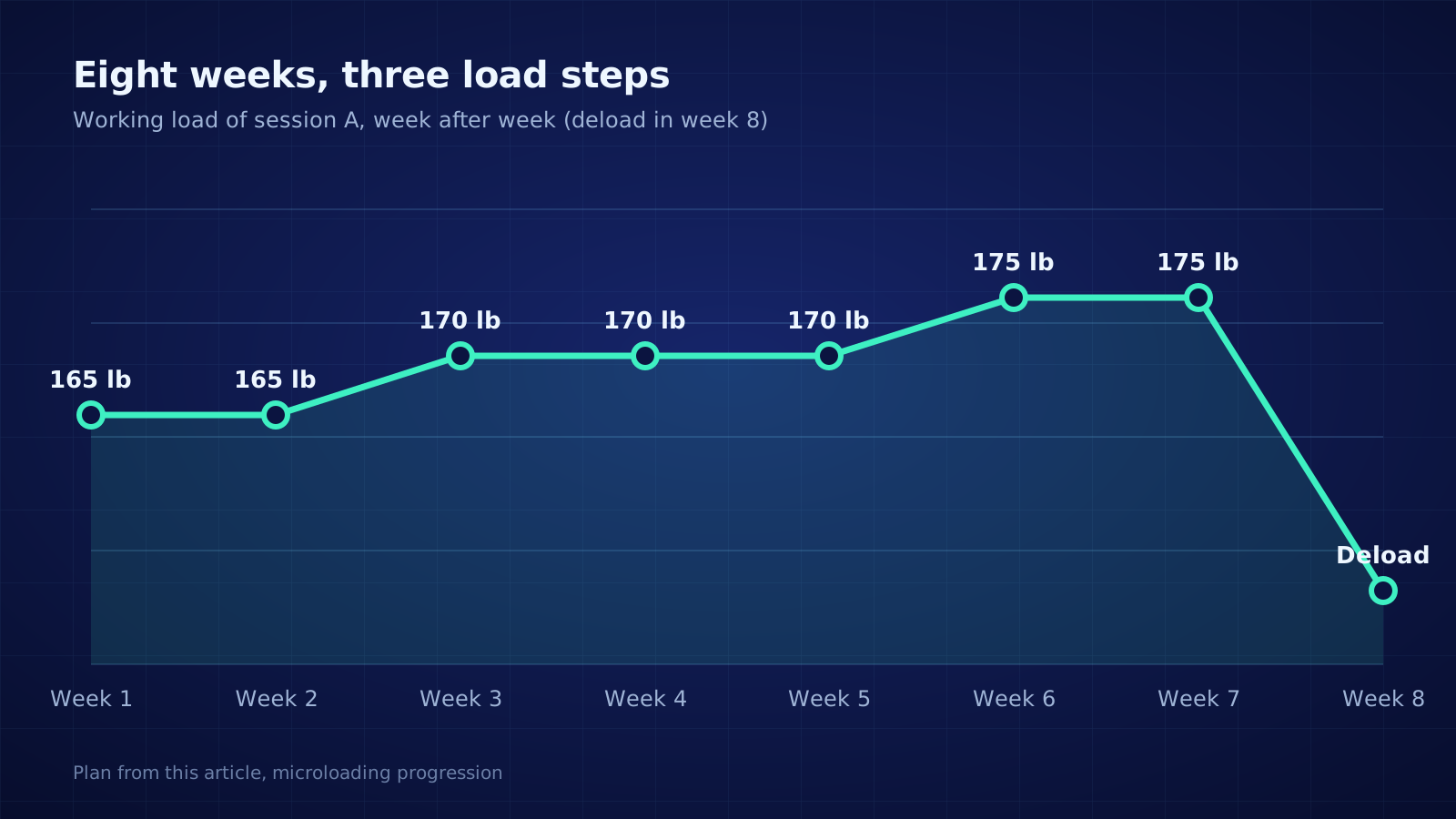
Starting point: your current 5RM. In week 1 you restart at 90% of that weight. The numbers below assume a 185 lb 5RM; adjust them. Session A is heavy; session B, three to four days later, combines the variation and assistance work.
| Week | Session A: bench press | Session B: variation and assistance | Marker |
|---|---|---|---|
| 1 | 4 × 5 at 165 lb (90% of 5RM), RIR 2 | Paused 2 s: 3 × 6 at 150 lb; incline DB press 3 × 10; dips 3 × 8 | Technique reset, everything logged |
| 2 | 4 × 6 at 165 lb | Paused 3 × 7; incline 3 × 10; dips 3 × 8 | Reps climb, weight stays |
| 3 | 4 × 4 at 170 lb | Paused 3 × 8; incline 3 × 11; dips 3 × 9 | New weight step |
| 4 | 4 × 5 at 170 lb | Paused 3 × 6 at 155 lb; incline 3 × 12; dips 3 × 10 | Mid-cycle |
| 5 | 4 × 6 at 170 lb | Close-grip 3 × 6; incline 3 × 10 with +5 lb; weighted dips 3 × 8 | Variation switch |
| 6 | 4 × 4 at 175 lb | Close-grip 3 × 7; incline 3 × 11; weighted dips 3 × 9 | New weight step |
| 7 | 4 × 5 at 175 lb (if a set fails, add only 2.5 lb next time) | Close-grip 3 × 8; incline 3 × 12; weighted dips 3 × 10 | Hardest week |
| 8 | Deload: 2 × 5 at 150 lb, then a 5RM test at the end of the week | Paused 2 × 6 light; assistance 2 sets | Recover, then test |
Expected outcome: a 5RM between 190 and 195 lb, a gain of 5 to 10 lb. It is not spectacular; it is what progressive overload produces in an intermediate, and it repeats cycle after cycle. Programs organized in cycles like this build more maximal strength than unstructured training (Williams et al., 2017).
The mistakes that keep you stuck
- Testing your max every week. A 1RM attempt is as tiring as a full session and builds nothing.
- Switching programs every three weeks. Your body never gets time to adapt; keep the plan for eight weeks.
- Piling on assistance sets. The bench press improves mainly through the bench press; assistance fixes a weak point, it does not replace the lift.
- Ignoring body weight. A hard cut rarely pushes the bench up; accept holding the weight steady during that period.
- Skipping the deload. The lighter week 8 is not wasted: it is where accumulated fatigue turns into a record.
Write down today's 5RM, pick your session B variation and start week 1 at your next session. The other guides on the blog are collected on the home page.
FAQ
How long does a bench press plateau usually last?
Three to four weeks with no gain in weight or reps, at the same technique, is a genuine plateau. Anything shorter is usually a bad week caused by sleep, stress or food. Past six weeks, change your progression method instead of grinding the same numbers.
Do I need to train to failure to break a bench press plateau?
No. The 2022 meta-analysis by Grgic and colleagues found no extra strength from taking sets to failure compared with stopping one or two reps short. Keep 1 to 2 reps in reserve on most sets, and save failure, if you want it at all, for the last set of a light variation.
Microloading or double progression: which should I use?
Both, together. Double progression decides when you add weight: once every set hits the top of the rep range. Microloading decides how big the jump is: 2.5 lb instead of 5 lb. An intermediate lifter who is stuck gets the most out of combining them.
How many times a week should I bench press?
Twice a week, three to four days apart, is the most reliable setup for an intermediate: one heavy session and one variation session. Three sessions can work if the total weekly volume stays the same and you recover. Once a week slows upper-body strength gains.
What if I am still stuck after the 8-week plan?
Check sleep, calories and how many sessions you actually completed: that is where most failures hide. Then swap the session B variation to match your sticking point and run another cycle starting at 85% of your 5RM instead of 90%. If two cycles change nothing, have a coach look at your technique.
Sources
- Plotkin D, Coleman M, Van Every D, et al. Progressive overload without progressing load? The effects of load or repetition progression on muscular adaptations. PeerJ, 2022. https://doi.org/10.7717/peerj.14142
- Schoenfeld BJ, Grgic J, Ogborn D, Krieger JW. Strength and hypertrophy adaptations between low- vs. high-load resistance training: a systematic review and meta-analysis. Journal of Strength and Conditioning Research, 2017. https://doi.org/10.1519/JSC.0000000000002200
- Grgic J, Schoenfeld BJ, Davies TB, et al. Effect of resistance training frequency on gains in muscular strength: a systematic review and meta-analysis. Sports Medicine, 2018. https://doi.org/10.1007/s40279-018-0872-x
- Schoenfeld BJ, Pope ZK, Benik FM, et al. Longer interset rest periods enhance muscle strength and hypertrophy in resistance-trained men. Journal of Strength and Conditioning Research, 2016. https://doi.org/10.1519/JSC.0000000000001272
- Grgic J, Schoenfeld BJ, Orazem J, Sabol F. Effects of resistance training performed to repetition failure or non-failure on muscular strength and hypertrophy: a systematic review and meta-analysis. Journal of Sport and Health Science, 2022. https://doi.org/10.1016/j.jshs.2021.01.007
- Kompf J, Arandjelović O. The sticking point in the bench press, the squat, and the deadlift: similarities and differences, and their significance for research and practice. Sports Medicine, 2017. https://doi.org/10.1007/s40279-016-0615-9
- Fonseca RM, Roschel H, Tricoli V, et al. Changes in exercises are more effective than in loading schemes to improve muscle strength. Journal of Strength and Conditioning Research, 2014. https://doi.org/10.1519/JSC.0000000000000539
- Zourdos MC, Klemp A, Dolan C, et al. Novel resistance training-specific rating of perceived exertion scale measuring repetitions in reserve. Journal of Strength and Conditioning Research, 2016. https://doi.org/10.1519/JSC.0000000000001049
- Knowles OE, Drinkwater EJ, Urwin CS, Lamon S, Aisbett B. Inadequate sleep and muscle strength: implications for resistance training. Journal of Science and Medicine in Sport, 2018. https://doi.org/10.1016/j.jsams.2018.01.012
- Williams TD, Tolusso DV, Fedewa MV, Esco MR. Comparison of periodized and non-periodized resistance training on maximal strength: a meta-analysis. Sports Medicine, 2017. https://doi.org/10.1007/s40279-017-0734-y