Why You Should Log Your Workouts (and What to Track)
Why you should log your workouts: what memory drops within days, why progressive overload needs data, what to write down each set and how to review it.

In brief
- Without a log you lose a session's numbers within days, and progressive overload becomes guesswork: it requires beating your previous session precisely, rep for rep.
- A log makes three invisible things visible: your real weekly volume per muscle, your weight and rep records, and plateaus while they are still short.
- The minimum per set is exercise, weight, reps and RIR. Then ten minutes a week to review the data and set targets for the next week.
If you want to know whether you are actually getting stronger, you need to log your workouts. Not a feeling, not a vague sense that the bench felt good: numbers, weight, reps and effort, session after session. Without them you train blind, and most people end up repeating the same workout for months while believing they are moving forward.
What your memory drops between sessions
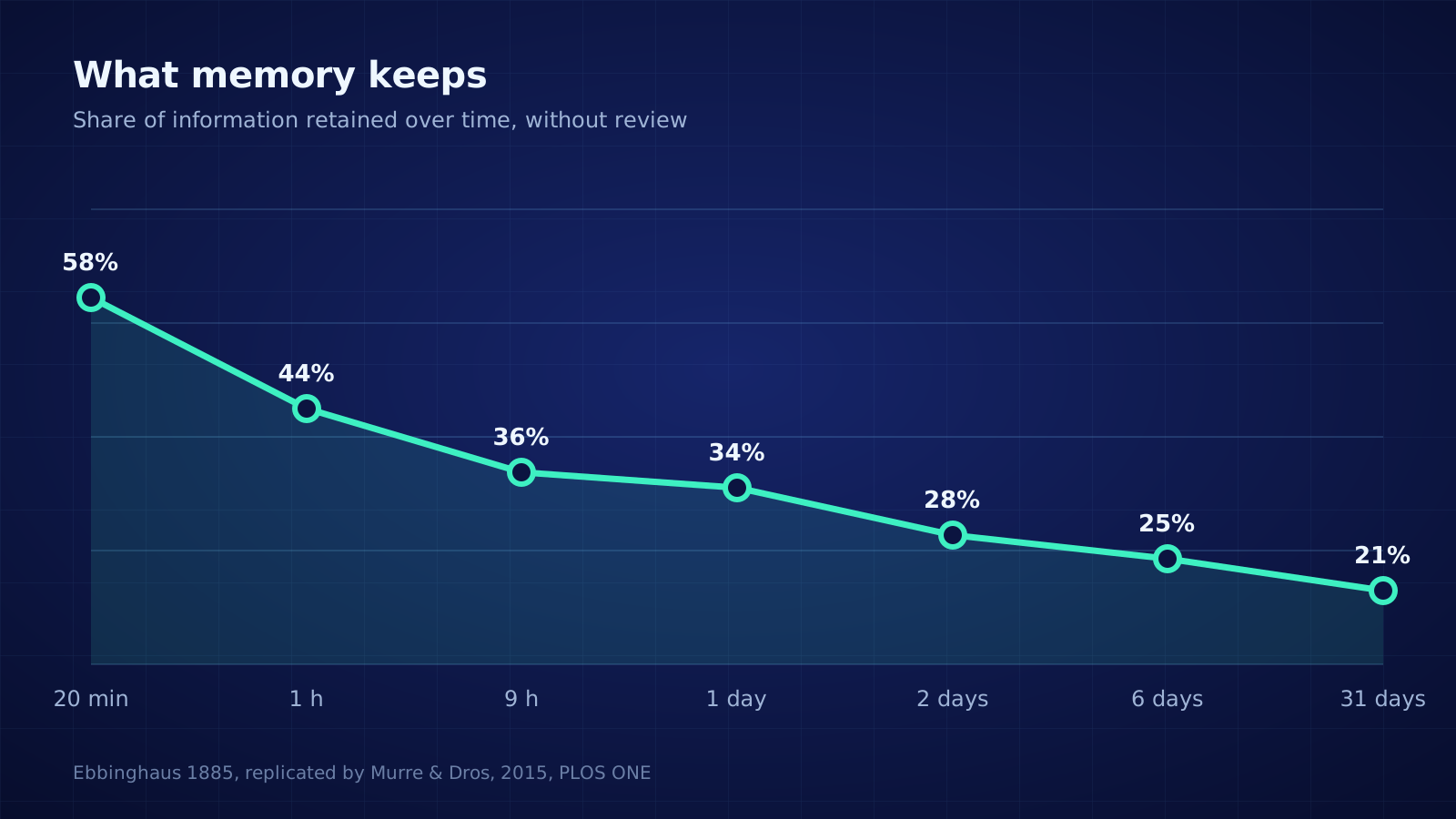
A single workout produces 40 to 60 numbers: five or six exercises, three or four sets each, a weight and a rep count per set. Your memory keeps the mood, not the values. You remember that squats were brutal, not that the third set stopped at 7 reps instead of 8.
The forgetting curve first described by Ebbinghaus, and replicated in 2015 by Murre and Dros, shows that most of what we memorize without reviewing it is gone within the first day. Between two leg sessions there are typically three to seven days, with two or three other workouts in between. What you think you remember is a reconstruction, and it usually flatters you. And every useful decision, adding 5 lb, chasing one more rep, backing off because fatigue is piling up, depends on the numbers you forgot.
No progressive overload without data
Progressive overload means gradually increasing the demand placed on a muscle: more weight, more reps, more sets or shorter rest. The American College of Sports Medicine's position stand makes it the central principle of progression in resistance training, and in 2022 Plotkin and colleagues showed that progressing by adding weight or by adding reps produced comparable muscle growth. Both roads work, as long as you actually progress.
But "progress" only exists relative to a reference point. Beating last session means knowing it, rep for rep. One extra rep on each of 3 bench sets is 3 extra reps, real progress that goes unnoticed without a log. If you are stuck on that lift, our guide to breaking a bench press plateau shows how to read those small gaps.
Double progression, the simplest rule to apply
You keep the same weight until you hit the top of your rep range on every set, then you add weight and start again from the bottom. With an 8 to 12 range: 135 lb × 8, 8, 8; then 135 × 10, 9, 9; then 135 × 12, 12, 11; then 145 lb × 8, 8, 8. Without the set-by-set detail from last time, this rule cannot be applied.
Volume per muscle cannot be estimated in your head
Volume is the number of hard sets a muscle gets in a week. The meta-analysis by Schoenfeld, Ogborn and Krieger found a dose-response relationship: 10 or more weekly sets per muscle produced greater gains in muscle mass than lower volumes. The detailed benchmarks are in our article on sets per muscle per week.
Counting that in your head is close to impossible, because most exercises hit several muscles. Bench press works the chest, but also the triceps and front delts; rows train the back and the biceps. To know how many sets your triceps really got this week, you have to add direct work and a share of indirect work across three or four sessions. That is a logbook calculation, not a memory task. And it almost always exposes an imbalance: chest overworked, hamstrings, calves or rear delts neglected.
Catch a plateau before it lasts three months
A plateau is an exercise whose numbers stop moving for three or four consecutive sessions at the same weight and reps. Without a log, you notice it once it has lasted three months, because the effort feels the same every time. With a curve per exercise, you see it in three weeks and can react: change the rep range, add a set, fix your rest periods, plan a lighter week.
A log also catches what memory misses: records. Not only weight PRs, but rep PRs at a given weight. Going from 185 lb × 6 to 185 lb × 8 is real progress, more frequent than a weight PR, and it is what sets up the next one.
Logging also keeps you consistent
The most underrated benefit of tracking is behavioral. The meta-analysis by Harkin and colleagues, published in Psychological Bulletin in 2016 across 138 experimental studies, found that monitoring progress toward a goal increases the odds of reaching it, and that the effect is stronger when progress is physically recorded rather than just observed. Michie and Abraham had already identified self-monitoring in 2009 as one of the most effective techniques in physical activity interventions.
To be fair about scope: these studies cover health behaviors in general, not lifting logs specifically. But the mechanism is the same: visible progress, even small, sustains motivation in a way that feel alone does not.

What exactly to write down each session
The useful minimum, per set:
- The exercise and its exact variation: barbell or dumbbell, grip, incline angle. A 30-degree incline press and a 45-degree one are not the same exercise.
- The weight, deciding once and for all whether you count the bar.
- The reps you actually got, set by set, not "3 × 10" if the last set stopped at 8.
- RIR, reps in reserve, the number of reps you could still have done. The scale proposed by Zourdos and colleagues in 2016 lets you rate the effort of every set without training to failure. 135 lb × 10 at 3 RIR and 135 lb × 10 at 0 RIR tell two different stories.
The next level up:
- Rest time, because it changes performance. The review by Grgic and colleagues found that rest periods of at least two minutes favor strength gains in trained lifters. Dropping from 3 minutes to 90 seconds sometimes explains a "plateau" that is not one.
- A free note: short night, cranky shoulder, trained fasted, different equipment. This is what explains a bad session three months later.
- Body weight, once a week, so you can read your lifts relative to it.
Paper log or app?
Both work, and a paper log kept consistently beats an app opened one session out of three. Here is an honest comparison.
| Criterion | Paper log | App |
|---|---|---|
| Entry during the workout | Fast, zero distraction | Fast if the weight is pre-filled |
| Volume per muscle | Calculated by hand every week | Calculated automatically |
| Weight and rep records | Found by flipping back | Detected as you log |
| Curve per exercise | Impossible without a spreadsheet | Instant |
| One year of history | Pages to flip through | Instant search |
| Risk of loss | High: forgotten, rained on, lost in a move | Low if data is backed up |
| Battery, notifications | Not an issue | To manage, airplane mode and offline use |
| Cost | $3 to $5 | Free to a few dollars a month |
The real criterion is what you do with the data. A paper log hands you the raw numbers and leaves all the analysis to you. An app does it for you, provided you pick one that actually calculates something instead of just storing sets.
In S-Load Every set you log automatically feeds your weekly volume per muscle, your weight and rep records, a session score out of 100 and a curve for every exercise. In training mode, last session's weight is pre-filled: you confirm reps and RIR while the rest timer runs. The Lab adds your weekly muscle distribution and a verdict per exercise. Everything works offline. The app is free; Premium is €4.99 a month or €34.99 a year, with a 7-day free trial.
How to use your data every week
Logging without reviewing is pointless. Take ten minutes a week, Sunday evening for instance, and answer five questions:
- Did every muscle get its target volume? A muscle under 8 sets two weeks in a row deserves one more set or a direct exercise.
- Which exercises progressed? Compare the last three sessions of each main lift. One more pound or one more rep counts. Nothing across three sessions is a signal.
- Is your RIR drifting? Every set at 0 RIR with reps going down, fatigue is stacking up. 4 RIR everywhere, you can load more.
- What do the free notes say? Three bad sessions after three short nights is not a programming problem.
- What are next week's targets? Write them ahead of time: "bench 145 lb × 8, 8, 8", "pull-ups, one more rep on the first set".
If you follow a structured program like Push Pull Legs, this review fits naturally at the end of each weekly cycle. And if you use an app like S-Load, most of these answers are already waiting in the Lab; what is left for you is the part that matters, the decision.
Open your notebook, or get the app, and log your next session set by set.
FAQ
Should I log every set or just my best set?
Every set. Your best set says nothing about the volume you actually did or the fatigue you built up. Adding up all your sets is what lets you count weekly volume per muscle, and your last set is what reveals your true RIR.
Does logging slow down a workout?
Not if you log during the rest between sets. It takes five to ten seconds per set, inside a rest period that usually lasts 90 to 180 seconds. If the weight is pre-filled from last time, you only enter reps and RIR.
What do I do with old data when I switch programs?
Keep it. A new program almost always reuses the same core lifts, and your old records remain the reference for setting starting weights. Exercise history is worth more than program history.
Is RIR reliable for beginners?
It becomes reliable with practice. Beginners tend to underestimate how many reps they have left in the tank. Log it anyway, even as a rough guess: comparing your estimate to the reps you actually get next session is how you calibrate it.
How long before a workout log starts paying off?
From your second session, since it is planned off your first. The payoff grows from there: at three weeks you see trends per exercise, at three months you spot plateaus, and at one year you know exactly what made you stronger.
Sources
- Harkin B., Webb T.L., Chang B.P.I. et al. Does monitoring goal progress promote goal attainment? A meta-analysis of the experimental evidence. Psychological Bulletin, 2016. https://doi.org/10.1037/bul0000025
- Michie S., Abraham C., Whittington C. et al. Effective techniques in healthy eating and physical activity interventions: a meta-regression. Health Psychology, 2009. https://doi.org/10.1037/a0016136
- Murre J.M.J., Dros J. Replication and analysis of Ebbinghaus' forgetting curve. PLOS ONE, 2015. https://doi.org/10.1371/journal.pone.0120644
- American College of Sports Medicine. Progression models in resistance training for healthy adults. Medicine & Science in Sports & Exercise, 2009. https://doi.org/10.1249/MSS.0b013e3181915670
- Plotkin D., Coleman M., Van Every D. et al. Progressive overload without progressing load? The effects of load or repetition progression on muscular adaptations. PeerJ, 2022. https://doi.org/10.7717/peerj.14142
- Schoenfeld B.J., Ogborn D., Krieger J.W. Dose-response relationship between weekly resistance training volume and increases in muscle mass: a systematic review and meta-analysis. Journal of Sports Sciences, 2017. https://doi.org/10.1080/02640414.2016.1210197
- Zourdos M.C., Klemp A., Dolan C. et al. Novel resistance training-specific rating of perceived exertion scale measuring repetitions in reserve. Journal of Strength and Conditioning Research, 2016. https://doi.org/10.1519/JSC.0000000000001049
- Grgic J., Schoenfeld B.J., Skrepnik M. et al. Effects of rest interval duration in resistance training on measures of muscular strength: a systematic review. Sports Medicine, 2018. https://doi.org/10.1007/s40279-017-0788-x