How Many Sets per Muscle Group per Week Should You Do?
Optimal weekly sets per muscle according to the meta-analyses: beginner to advanced benchmarks, how to count a set, training frequency and signs of excess.
In short
- To build muscle, aim for 10 to 20 working sets per muscle group per week. That is the range supported by the Schoenfeld (2017) and Baz-Valle (2022) reviews.
- A set only counts if it is taken close to failure (0 to 3 reps in reserve), lands between 6 and 20 reps, and targets the muscle directly. Warm-up sets do not count.
- Split that volume across 2 sessions per muscle each week. Beyond 20 sets, the extra gain is small and fatigue climbs fast.
How many sets per muscle group per week you do is the simplest lever for growing a muscle, as long as you set it correctly. Too few and you stall. Too many and you pile up fatigue without extra growth. The research now gives a fairly tight range and, just as important, a way to count sets the same way every week.
How many sets per muscle group per week build muscle?
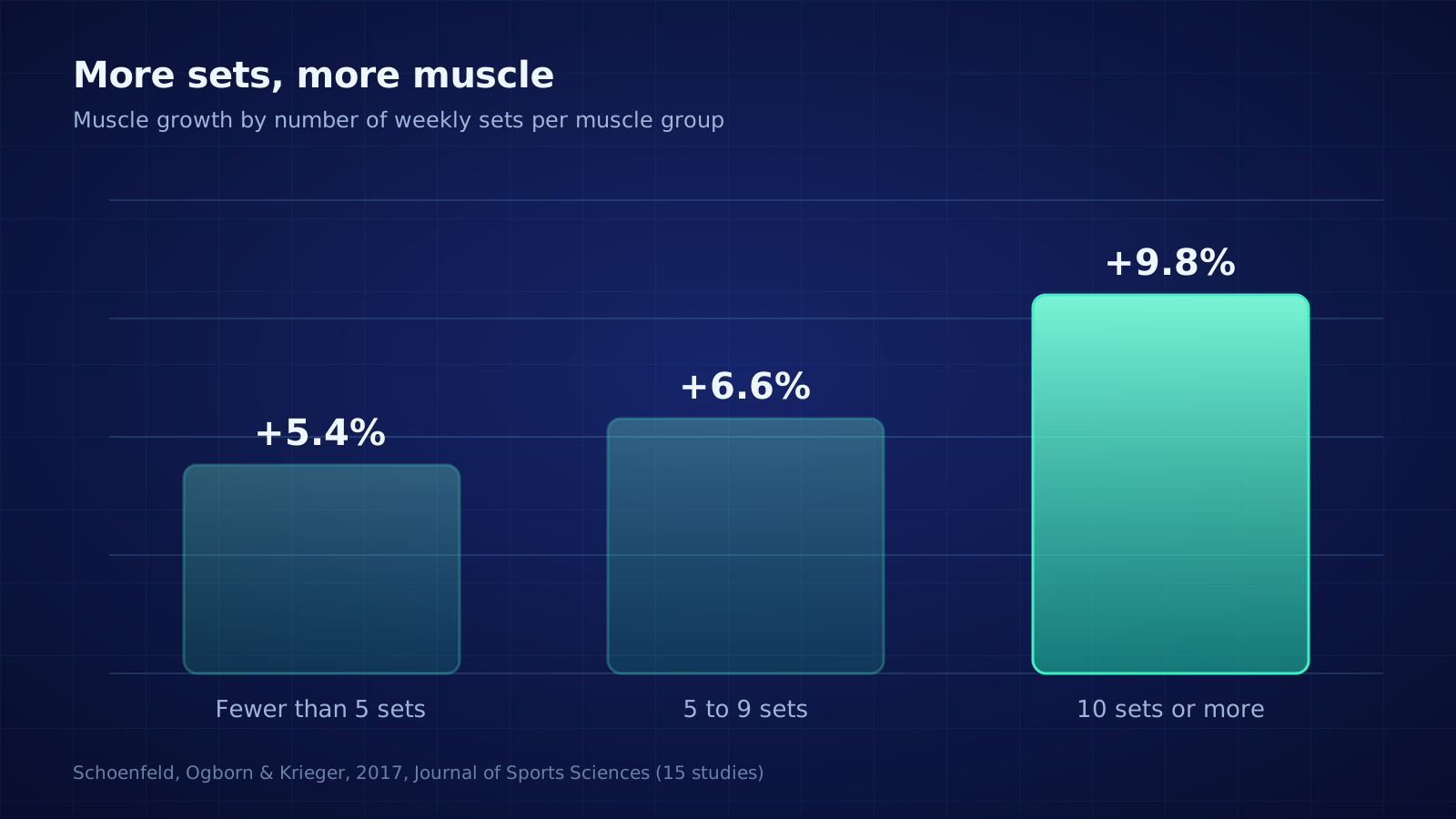
The reference point is still the meta-analysis by Schoenfeld, Ogborn and Krieger (2017), which pooled 15 studies and 34 training groups. Each extra weekly set was associated with roughly 0.37% more muscle growth, and higher-volume protocols gained on average 3.9% more than lower-volume ones over the length of a study. Groups performing 10 or more weekly sets outgrew those doing fewer than 5.
Baz-Valle and colleagues (2022) reviewed studies on trained men and narrowed the window: 12 to 20 sets per muscle group per week may be "an optimum standard recommendation". Above 20, quads and biceps showed no clear extra benefit; only the triceps seemed to respond to more.
Pelland and colleagues (2024), in a meta-regression still in preprint, describe a curve with diminishing returns: gains rise with volume, but more and more slowly. Going from 6 to 12 sets changes a lot. Going from 18 to 24 changes very little.
One number to remember: 13 sets
If you only keep one figure, keep 13 sets per muscle group per week. It sits inside the zone where the studies agree, it fits comfortably into 2 sessions, and it leaves room to push a lagging muscle higher without drifting into junk volume.
What are the benchmarks for beginners, intermediates and advanced lifters?
Most of the studies above used lifters with at least a year of experience. A beginner grows on less, because every set is still a new stimulus. An advanced lifter needs more, because the muscle has adapted. Schoenfeld and Grgic (2018) set the floor at around 10 weekly sets per muscle and stress that the right dose is individual. Treat the table as practical benchmarks, not hard thresholds.
| Level | Sets per muscle group per week | Sessions per muscle | What matters most |
|---|---|---|---|
| Beginner (under 1 year) | 8 to 12 | 2 | Everything works; technique beats volume |
| Intermediate (1 to 3 years) | 10 to 16 | 2 | The most productive part of the dose-response curve |
| Advanced (3 years and up) | 12 to 20 | 2 to 3 | The top of the range for 1 or 2 priority muscles, not for all of them |
You do not have to max out every muscle. A sensible program puts 12 to 16 sets on the big groups (back, chest, quads) and 8 to 12 on the smaller ones (biceps, triceps, shoulders, calves), which already get indirect work from compound lifts.

How do you count a set?
This is where most calculations go wrong. Two lifters who both "do 15 sets of chest" may actually be doing 8 or 22 depending on how they count. The review by Baz-Valle, Fontes-Villalba and Santos-Concejero (2021) validates total set count as a volume measure under three conditions: sets are taken to failure or close to it, reps fall roughly between 6 and 20, and the other variables stay constant.
In practice:
- A working set ends with 0 to 3 reps in reserve (RIR is the number of reps you could still have done). A set stopped at 6 RIR does not count.
- Warm-up sets and ramp-up sets do not count.
- A set of 6 to 20 reps counts once. A heavy triple counts for strength but carries less weight for hypertrophy.
- A set on a compound lift counts in full for the primary muscle. For secondary muscles (triceps on the bench press, biceps on pull-ups), the common convention is half a set. That is an approximation, not a research finding.
Counting by hand in a notebook gets tedious fast. It is one of the main reasons to log every workout in a tool that adds it up for you.
Should you train each muscle once or twice a week?
Total volume matters more than how it is spread, but the spread still counts. The meta-analysis by Schoenfeld, Ogborn and Krieger (2016) found that training a muscle twice a week produced more hypertrophy than once. A later analysis (Schoenfeld, Grgic and Krieger, 2019) refined this: when weekly volume is matched, frequency no longer has a significant effect.
The practical reading is simple: frequency is a tool for fitting the volume in cleanly. Doing 15 sets of back in one session means the last 5 are done tired, with the weight dropping. The same 15 sets across 2 sessions of 7 to 8 are all high quality. That is the whole logic of a 6-day Push Pull Legs split, where every muscle comes around twice a week.
Beyond 2 sessions per muscle, the benefit is mostly for advanced lifters who exceed 16 sets and want to split them into 3 shorter blocks.
What are the signs you are doing too many sets?
More is not always better, and one study makes the point well. Aube and colleagues (2022) compared 12, 18 and 24 weekly sets over 8 weeks in 35 trained lifters (squat above twice bodyweight). Muscle thickness improved the same in all three groups. Squat strength followed a bell curve: +16.2% at 18 sets, +11.3% at 12 sets, and only +5.4% at 24 sets.
Separately, Schoenfeld and colleagues (2019) found that 1, 3 or 5 sets per exercise, 3 times a week, produced identical strength gains in trained men, even though the high-volume group grew more. Volume beyond what you need adds nothing to strength and may hold it back.
The warning signs:
- Your working weights drop week over week on the same lifts, while your food and sleep are in order.
- Your joints ache before you have even warmed up.
- You no longer feel like going to the gym, which is usually accumulated fatigue rather than a motivation problem.
- Your sessions run past 90 minutes because you keep stacking exercises.
The right response is not to add more, but to drop back to 10 to 12 sets for two weeks and then rebuild gradually. If you are stuck on the bench press, check your total chest and triceps volume before you swap exercises.
How do you track volume per muscle without errors?
Weekly volume is not something you feel; it is something you count. The catch is that the count has to be identical every week to be useful: same definition of a set, same muscle assignment, same Monday-to-Sunday window.
In S-Load The Home screen shows one bar per muscle with the number of sets completed since Monday. Every set you tick off during a workout is credited to the exercise's primary muscle, with nothing to calculate. The color runs from brick red (a neglected muscle, 0 sets) to cyan at 13 sets, the point where the bar is full and stays steady. One glance is enough to spot the lagging muscle before you plan your next session. Learn more at sload.app.
Once the volume is visible, adjusting it becomes concrete: a muscle that stays red two weeks in a row needs more sets; a muscle above 20 sets that is not progressing is getting too many. Adjust in steps of 2 sets per week, never more, and give each change 3 to 4 weeks before you judge it.
Pick one lagging muscle, add 2 sets to it this week, and write down what happens.
FAQ
How many sets per muscle group per week for a beginner?
Between 8 and 12 working sets per muscle group per week is enough in the first year. A beginner's muscle responds to a small stimulus, and the priority is learning technique with progressively heavier weights. Spread over 2 sessions, those sets already produce visible results.
Do warm-up sets count toward weekly volume?
No. Only sets taken close to failure, with 0 to 3 reps in reserve, count as useful volume for hypertrophy. A warm-up set at 50% of your working weight does not deliver the required stimulus and should not be added to the total.
Is it better to do 10 heavy sets or 20 light sets?
Between 6 and 20 reps, a set taken close to failure counts the same for muscle growth. The choice depends on your recovery and your joints, not on the load itself. Ten heavy sets tax the nervous system more; twenty light sets take more time.
Can you do 20 sets for one muscle in a single session?
You can, but it is rarely efficient. The last sets of a long session are performed fatigued, with dropping loads and degraded technique. Splitting those 20 sets into 2 sessions of 10 gives you better-quality sets for the same weekly volume.
How does S-Load count sets per muscle?
S-Load adds up every set you complete during a workout and credits it to the exercise's primary muscle, over a Monday-to-Sunday week. The Home screen shows one bar per muscle, from red to cyan, full from 13 sets onward. You can see at once which muscle has had enough work and which one is behind.
Sources
- Schoenfeld BJ, Ogborn D, Krieger JW. Dose-response relationship between weekly resistance training volume and increases in muscle mass: A systematic review and meta-analysis. Journal of Sports Sciences, 2017. doi.org/10.1080/02640414.2016.1210197
- Baz-Valle E, Balsalobre-Fernández C, Alix-Fages C, Santos-Concejero J. A Systematic Review of the Effects of Different Resistance Training Volumes on Muscle Hypertrophy. Journal of Human Kinetics, 2022. doi.org/10.2478/hukin-2022-0017
- Schoenfeld BJ, Grgic J. Evidence-Based Guidelines for Resistance Training Volume to Maximize Muscle Hypertrophy. Strength and Conditioning Journal, 2018. doi.org/10.1519/SSC.0000000000000363
- Baz-Valle E, Fontes-Villalba M, Santos-Concejero J. Total Number of Sets as a Training Volume Quantification Method for Muscle Hypertrophy: A Systematic Review. Journal of Strength and Conditioning Research, 2021. pubmed.ncbi.nlm.nih.gov/30063555
- Schoenfeld BJ, Ogborn D, Krieger JW. Effects of Resistance Training Frequency on Measures of Muscle Hypertrophy: A Systematic Review and Meta-Analysis. Sports Medicine, 2016. doi.org/10.1007/s40279-016-0543-8
- Schoenfeld BJ, Grgic J, Krieger J. How many times per week should a muscle be trained to maximize muscle hypertrophy? A systematic review and meta-analysis. Journal of Sports Sciences, 2019. doi.org/10.1080/02640414.2018.1555906
- Schoenfeld BJ et al. Resistance Training Volume Enhances Muscle Hypertrophy but Not Strength in Trained Men. Medicine & Science in Sports & Exercise, 2019. pubmed.ncbi.nlm.nih.gov/30153194
- Aube D et al. Progressive Resistance Training Volume: Effects on Muscle Thickness, Mass, and Strength Adaptations in Resistance-Trained Individuals. Journal of Strength and Conditioning Research, 2022. pubmed.ncbi.nlm.nih.gov/32058362
- Pelland J, Remmert J, Robinson Z, Hinson S, Zourdos M. The Resistance Training Dose-Response: Meta-Regressions Exploring the Effects of Weekly Volume and Frequency on Muscle Hypertrophy and Strength Gain. SportRxiv (preprint), 2024. doi.org/10.51224/SRXIV.460